Case Study: Product Mindset Cohort Transformation
Helping Cross-Functional Teams Build Shared Understanding Around Product Thinking
The Challenge
A large enterprise organization was working to strengthen Product Mindset adoption across multiple departments and teams. While individuals were interested in product thinking principles, adoption was inconsistent and fragmented across the organization.
Teams were navigating several interconnected challenges:
- siloed communication between departments,
- inconsistent understanding of Product Mindset concepts,
- difficulty translating theory into day-to-day practice,
- limited cross-functional collaboration,
- and uncertainty around how to sustain long-term behavioral change.
The organization needed more than a training program. It needed a collaborative learning environment capable of supporting organizational transformation through shared understanding, mentorship, and applied practice.
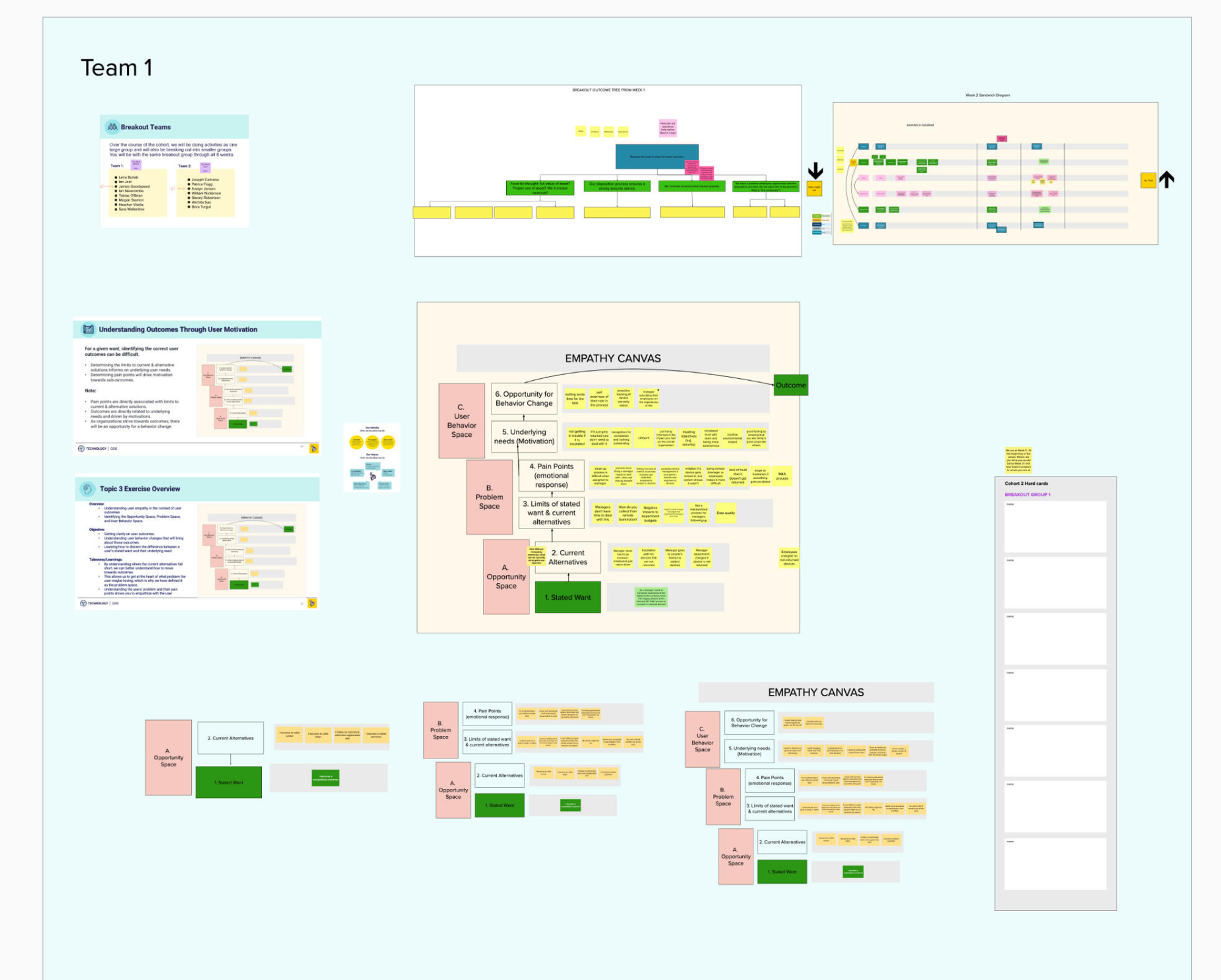
The Approach: Building Collaborative Learning Systems
To support sustainable adoption, I helped design and facilitate a Product Mindset Cohort initiative focused on creating shared language, collaborative learning structures, and scalable mentorship practices across the organization.
Rather than treating transformation as a top-down rollout, the cohort model emphasized:
- participatory learning,
- cross-functional collaboration,
- peer mentorship,
- experimentation,
- and organizational sensemaking.
The initiative combined facilitation, systems thinking, coaching, and collaborative learning design to help participants explore how Product Mindset principles could be applied within their own organizational contexts.
Organizational Context & Complexity
The organization operated across multiple departments with differing workflows, priorities, and interpretations of product thinking.
Some of the key tensions included:
- balancing delivery pressures with discovery-oriented thinking,
- creating consistency without rigid standardization,
- supporting experimentation within existing organizational structures,
- and helping teams shift from siloed execution toward collaborative product ownership.
The challenge was not simply informational. It was behavioral and relational.
The work required creating environments where participants could:
- collaboratively explore new ways of thinking,
- learn from one another across organizational boundaries,
- and build confidence navigating uncertainty together.
The Process
Phase 1: Cohort Design & Alignment
The program structure was designed around:
- collaborative learning
- mentorship
- practical experimentation
- and cross-functional dialogue
Key components included:
- facilitated cohort sessions
- topic-based learning modules
- shared discussion spaces
- mentorship opportunities
- and reusable learning assets
The goal was not only to teach concepts, but to help participants build shared understanding through active engagement and reflection.
Phase 2: Facilitation & Collaborative Learning
Facilitated sessions focused on:
- product thinking principles
- customer-centered collaboration
- systems awareness
- communication practices
- and organizational learning
Participants explored real organizational challenges together rather than working exclusively through hypothetical exercises.
The cohort structure encouraged:
- peer-to-peer learning
- collaborative problem solving
- and the development of relationships across departmental boundaries
Phase 3: Mentorship & Organizational Adoption
To support long-term sustainability, the initiative incorporated:
- mentorship structures
- reusable facilitation materials
- shared learning resources
- and collaborative support systems
Participants were encouraged to adapt Product Mindset practices within their own teams and contexts, helping transformation emerge organically through distributed leadership and experimentation.
The Results
Organizational Outcomes
The initiative supported:
- 36 Product Mindset Champions across six departments
- 88% Return on Expectations (combines engagement scores and measures of the predefined expectations and outcomes) for all three cohorts
- There has been a 77% increase in Cohort members applying a Product Mindset after completing a Cohort as observed by their managers and other stake holders
- increased engagement and adoption of Product Mindset practices via the cohorts champions
- stronger cross-functional collaboration
- and improved shared understanding around customer-centered ways of working
The cohort structure created opportunities for participants to:
- build relationships across organizational silos
- explore challenges collaboratively
- and develop greater confidence navigating ambiguity and change
Transformation Outcomes
The initiative also contributed to:
- the development of reusable learning assets
- scalable mentorship structures
- collaborative facilitation practices
- and more adaptive approaches to organizational learning
Rather than relying solely on top-down change management, the cohort model helped create distributed ownership and collaborative participation around transformation efforts.
Thank you so much for all of your work leading the 3rd Product Mindset Cohort! I can truly say that this will improve my product practice as well as [Department] and [Company] overall!
- A Portfolio Product Owner & Cohort Champion
Key Insights: Transformation Through Shared Understanding
This work reinforced an important insight about organizational transformation:
Most transformation challenges are not failures of intelligence or motivation. They are failures of shared understanding.
People often struggle not because they are resistant to change, but because:
- language is fragmented
- systems are disconnected
- priorities compete
- and organizational complexity becomes difficult to navigate collaboratively
The cohort model created space for participants to:
- learn together
- experiment together
- and make sense of complexity together
That shared sensemaking process became one of the most important drivers of adoption and engagement.
You created an environment where it was safe and comforting for people like me to speak up. That in itself is the most precious thing IMO.
- Product Owner & Cohort Champion
Complexity as Collaborative Practice
This case study demonstrates how organizational transformation becomes more sustainable when people are invited into:
- collaborative learning
- participatory exploration
- and adaptive experimentation
Rather than attempting to eliminate uncertainty, the initiative helped participants build greater comfort navigating complexity together.
The result was not simply increased knowledge transfer, but the development of collaborative capacity across teams and departments.
Applications for Organizations
This approach is particularly effective for organizations navigating:
- Product Mindset adoption
- cross-functional transformation
- collaborative operating model redesign
- organizational learning initiatives
- and culture change efforts requiring shared understanding and adaptive thinking
The Product Mindset Cohort initiative demonstrates how facilitation, systems thinking, mentorship, and collaborative learning can help organizations create more adaptive, connected, and human-centered ways of working.